
Little Learners in Walnut Creek: Growing the Confidence to Step into Kindergarten
Updated: May 6
Kindergarten might be walking like gigantic feet. The problem of that leap is revered in the Preschools & Kindergarten Walnut Creek. They don't rush it. They get used to it one level after another, until the term kindergarten turns thrilling, not scary.
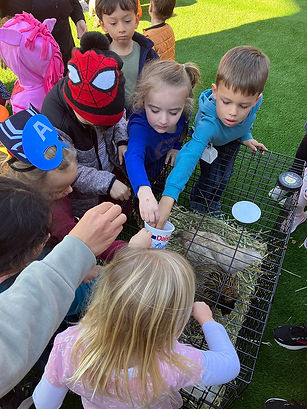
Go to a local preschool at mid morning hours and you will not see children boring flash cards for hours on hours. You'll see paint on smocks. Blocks stacked high. One of the teachers was sitting low, listening, with the nearest attention, to a story of a lost tooth, or of a new puppy. It looks simple. It isn't.
These are the years of training. The practice in the light of the main stage of kindergarten.
Before Curriculum Confidence.
One fact that is evident in the preschools in Walnut Creek is that confidence is a motivator of learning. A thinking child, I can make an attempt, is half the way there.
In the majority of classrooms, children choose their activities in certain blocks of time. That choice matters. It makes them know that their interests are important. A child can be fascinated with puzzles. Another can also visit the art easel directly. One of the thirds is drawn to the sensory table, covered with rice or sand on the hands.
The teachers are not helicopters. They observe. They step in when needed. They step back when possible.
It is that harmony that brings inner power. Such children are already used to the coping strategies that kindergarten imposes on them. They have trained on decision making. They have adopted the habit of seeing things to the latter.

How to Sit, Listen and Speak.
In Kindergarten, there is group interaction. Circle time becomes longer. Orders are more strata-layered. Preschool prepares kids for such change in very mild forms.
Classes at Walnut Creek begin with circle time. Five minutes. Then ten. The stories grow slightly longer as the year goes by. Teacher posed questions are open ended. So what is the second thing to do? Why was the character sad?
Children are shown how to lift hands. They learn to wait. At four, there is much to wait. It feels like an eternity. Yet by repetition they can do.
And they learn to speak up. this waste of time is no cute tales. It is speech making in short. A child is facing other children and proves the importance of a stuffed animal or drawing. That act builds courage.
An introverted child would stammer out at the start. The teacher cajoles, we want to hear you. A couple of weeks later, the same child is articulate. The expansion is directly passed on to the kindergarten classrooms.
Early Literacy without Coercion.
Parents are normally concerned with the kindergarten reading level. Walnut Creek day cares respond with unshaken confidence.
Everywhere are letters, and not as hard work. The walls contain alphabet charts. Labels mark shelves. Sweet nooks are crammed with storybooks. On a daily or sometimes twice a day basis, the teachers read aloud.
Children start learning letters in their names. That is normally the inception of the first one. Then they see the writing on the signs in the streets or cereal boxes. Learning does not take place just in the classroom.
Phonemic awareness plays creep in games. Rhyming songs. Silly word swaps. "Cat, hat, bat." Laughter follows. They do not feel that they are learning. They are just using sound in games.
It is a non-burnout strategy. K kindergarten teachers such as when the children are interested in reading but not so fatigued of reading.
Math in Motion
It is not left on paper to be counted. It moves.
Children count snack pieces. They number the playground. They categorize blocks according to size and color. On the highest tower they are contrasted.
These transactions comprise the number sense per se. The child who learns more and less with real objects will learn later based on worksheets.
Simple board games: Simple board games are a means of teaching counting spaces and turn taking. It is filled with the usage of measuring cups in a make-believe kitchen. None of it feels forced. However, the foundation is prepared in a discreet way.
Kindergarten math is not that much of a surprise since the concepts are not new.
The social skills in this movie are presented in a veiled curriculum.
Academic skills matter. Social skills are in most instances significant.
The preschools in Walnut Creek are considered as an opportunity for conflict. There are two children following the same truck. The discussion will be provided by the teachers, not by the adult arbitration.
"How can we solve this?"
Children suggest ideas. Take turns. Use a timer. Find another toy. These problem solving meetings are conducted on a daily basis.
By the time such children join kindergarten, they have compromised dozens of times already. They know how to say, I am still using that. They know what it means to say, May I have a go next?
Teachers also place importance on empathy. Children are questioned about the situations when one of their classmates cries. "What could we do to help?" This is an invention of self-interest consciousness.
The achievement of kindergarten classes is related to the possibility of cooperation among students. Preschool lays that principle stone after stone.

Independence in Small Tasks
Teachers in Kindergartens allow learners to do things simple by their own capabilities. Hanging backpacks. Opening lunch containers. Lack of handwashing as a reminder.
The practices of these skills are done at the Walnut Creek preschools.
The children are taught about the techniques of zipping jackets. It takes time. And sighs and matted sleeves. The teachers are not keen on correcting all the things instantly. They coach instead. "Try again." "Flip it over." "You've almost got it."
These moments matter. Self-dependence is done through mastering minor activities. When a child can open a snack, he or she is confident that he or she is competent.
This kind of ability is something that reduces the anxiety level on the first day of kindergarten.
Emotional Control as Superpower.
Massive feelings do not pass away when a person is half a decade old. They often intensify.
Frustration and disappointment managing tools are introduced into preschool classrooms. Breathing in exercises has become normal. Shatter the candle, Smell the flower. It sounds playful. It works.
Calm down corners are a peaceful place to rest. A child is trained to understand that one is allowed to walk out. Their desire to have a moment is not put down.
The teachers label emotions. "You look frustrated." "You seem excited." Improving emotions through labeling helps the children to manage the emotions.
This emotional wording is gold in kindergarten where the degree of anticipation is increased. A child that can say, I am overwhelmed, not beating up is at an advantage.
Security is developed by Routine Structures.
Kindergarten is timetable based. At the preschool level, the rhythm is presented.
In the morning, there is no change in routines. Arrival. Free play. Circle time. Snack. Outdoor play. Story time. The pattern repeats.
Predictability minimizes stress. Children know what is coming up. They relax into the day.
Of course, every now and then, some changes do occur. A special visitor. A fire drill. Teachers prepare children. They expound on what is to occur.
The training lessens the fear of the unknown. There are a lot of new experiences in Kindergarten. Preschool helps the children to face change to some extent of stability.
Encouraging Curiosity
It requires one to be inquisitive to make a confident leap into kindergarten.
Walnut creek preschools encourage questions always. Why do leaves change color? How do magnets work? What happens when colors mix?
Educators do not rush so fast to provide everything. They prank around with the children. They formed small experiments. They observe.
This is an ambitious statement, learning is not a task, it is an adventure.
Formal lessons are presented in kindergarten. Children who already consider learning an exciting process learn faster. Instead, they curve forward instead of withdrawing.
Certain Issues of Parent Communication.
Preparation of Kindergart is not done on the inside of the classroom only.
Preschools keep parents in touch. They share observations. They discuss strengths and weaknesses that need to be made better.
When an issue of fine motor skills is observed in a child, teachers suggest the activities to be performed at home. The scissors used should be safe on children. Playing with clay. Drawing with fatter pencils.
Continuity comes as a result of this partnership. At home and at school both children are encouraged.
It also provides the parents with confidence. They no longer wonder about every milestone. They have a vision of growth in a slow manner.
The Final Months Before the Leap.
As kindergarten approaches, it is very slow that the expectations of the preschool teachers are increased.
The circle times are prolonged a few minutes. Children are even taught to line up by themselves. They train to take multi-step tasks.
The question of what the kindergarten might be like is discussed. You will receive a larger play ground. "You might have a desk." The enigma is rendered to a certain extent.
Some of the classrooms visit a local elementary school playground. Abstract fears are made real by that adventure alone.
Children begin to talk kindergarten expectantly. "I'm going to be a big kid." Pride replaces hesitation.
That shift is the true goal.
The preschools of Walnut Creek do not take kids and let them fall off a cliff and fly. They build wings slowly. They test them in safe spaces. They would drop children and then they would take another try.
The jump does not yet appear a jump into the dark when kindergarten comes but it more appears a jump into a better and newer light.
Small shoes. Big confidence. Ready.
Tags: Preschools Walnut Creek, Quality Early Learning Schools, Prepare Children for Academic Excellence


Comments